
To start a softgel capsule manufacturing business in India, sound technical planning with regulatory compliance is must.
Here is an overlook of all requirements :-
| Operational Factor | Key Requirement for India (2026) |
|---|---|
| Minimum Required Area | 3,000 to 5,000 Square Feet (Schedule M Compliant) |
| Primary Regulatory Bodies | CDSCO (State Drug Authority) & FSSAI (Food Safety) |
| Core Machinery Needed | Gelatin Melting Tank, Encapsulation Machine, Tumble Dryers |
| Estimated Startup Capital | ₹1.5 Crore to ₹4 Crores (Depending on plant scale) |
The cost is lower if you choose third-party manufacturing instead of setting up your own plant.
While this snapshot has shown you a big picture, you should understand some technical and regulatory details for a successful launch. Keeping this in mind, we have come up with this step-by-step blueprint to help you understand how to start a softgel capsule manufacturing business.
A complete manufacturing unit needs proper planning, finance and technical execution.
These key steps will help you set your business operations the right way.
It is important for any business to know what the market needs.
Decide whether you want to specialize in pharmaceutical drugs or dietary supplements.
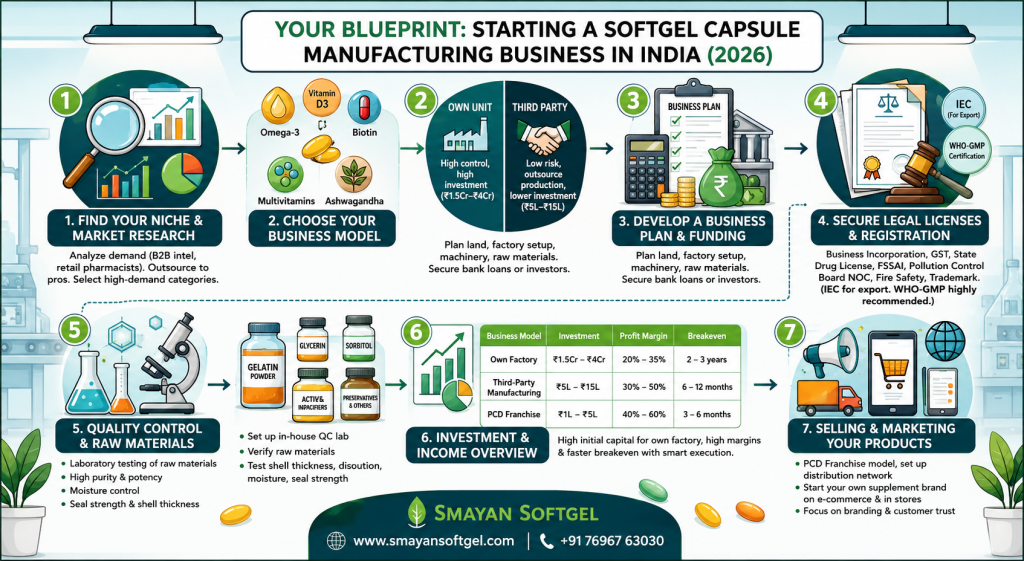
To perform an effective market research, you can analyse consumer demand provided by any B2B healthcare intelligence firm. Also, get direct feedback from your local retail pharmacist to figure out the performance of softgel brands.
Of course, it is quite overwhelming to do it yourself. You can source this responsibility to professionals handling digital intelligence tools, field-level trade sources, and pharma data providers. Based on those insights, you can easily find a profitable niche for you.
High-demand softgel categories in India right now include Omega-3 fish oil, Vitamin D3, Biotin, Multivitamins, and Ashwagandha extracts. These are proven sellers with consistent B2B demand — ideal niches for beginners.
Generally, there are two business models to choose from while starting a softgel capsule manufacturing business in India.
You can get started by setting up your own manufacturing facility, and buy the machinery. You have total operational control. But it requires you to invest a huge sum of money that can be in crores.
This is an ideal model of a beginner or someone with a small investment. You outsource the production to a third party softgel manufacturing company in India. It means that you will get your products manufactured, packaged and labelled from them. It is a low risk option.
If you want to set up a manufacturing facility, calculate the cost of land, factory setup, machinery and raw materials. A good plan will help you get bank business loans or attract private investors. It will be a great help to start your softgel capsule production business with less obstacles.
For a physical production unit, you need a dedicated industrial space. It has to meet strict government design laws for clean production.
You will need at least 3,000-5,000 square feet of industrial space. The layout should be as per the Schedule M guidelines of Drugs and Cosmetics Act of India. It needs separate sections of:
For running a modern softgel capsule manufacturing plant, invest in good quality automated machines.
The basic machine layout consists of:
| Core Machinery | Primary Function in the Production Line |
|---|---|
| Gelatin Melting Tank | Heats and prepares the hot liquid gelatin mass used to form the outer shell. |
| Medicament Mixing Tank | Blends and prepares the inner oil, liquid paste, or active ingredient formula. |
| Softgel Encapsulation Machine | Acts as the heart of the process; it forms the capsule shell and injects the liquid filling simultaneously. |
| Tumble Dryers | Removes the initial surface moisture from the capsules immediately after they are formed. |
| Drying Trays and Tunnels | Fully dries the capsules by removing remaining moisture over a period of 24 to 48 hours. |
| Sorting and Inspection Machines | Automatically detect, flag and remove any deformed or misshaped capsules. |
India has a regulated pharmaceutical sector. It clearly means that you should have government approvals in place to start your pharma business.
Therefore, secure the following licenses and registrations.
| Legal Registration / License | Mandatory Purpose & Applicability |
|---|---|
| Business Incorporation | Private Limited or LLP structure |
| GST Registration | Compulsory for all business billing |
| State Drug Manufacturing License | Form 25 or Form 28 |
| FSSAI License | Important if you are manufacturing nutraceutical supplements |
| Pollution Control Board NOC | Air and water discharge clearance |
| Fire Safety Certificate and Local Factory Permit | Standard municipal and safety clearance |
| Trademark Registration | Protects your unique brand names |
To export your products overseas, secure an Importer Exporter Code (IEC).
Also, you will require a WHO-GMP certification to demonstrate international quality standards.
Your brand’s success will be determined by the quality of your raw materials such as…
1. Gelatin Powder: Can be from animals or plant-based (vegan carrageenan)
2. Plasticizers: Sorbitol or glycerin to keep flexibility of the capsule shell.
3. Active ingredients: Oils, vitamins, herb extracts or chemical drugs.4. Coloring agents and opacifiers: Provides different colors and protects light sensitive fillings.
You also need to set up an in-house lab to verify all raw material batches before they are sent to line production. Test the finished softgels for shell thickness, dissolution rates, moisture levels and seal strength. Properly maintain batch records for government inspection.
Like we said before, a physical factory requires a lot of capital to get going. Normally, a small to medium factory costs between ₹1.5 crore to ₹4 crores. This includes land lease, machinery set up, raw materials and initial payroll. The margins are good in this business.
| Business Model | Investment | Profit Margin | Breakeven |
|---|---|---|---|
| Own Factory | ₹1.5Cr – ₹4Cr | 20% – 35% | 2 – 3 years |
| Third-Party Manufacturing | ₹5L – ₹15L | 30% – 50% | 6 – 12 months |
| PCD Franchise | ₹1L – ₹5L | 40% – 60% | 3 – 6 months |
Standard supplements can earn up to 20% to 35% profit margin. Specialty or custom formulations can earn as much as 50% profit. Most well-run plants reach their breakeven point within 2 to 3 years of continuous operation.
Production is only half the fight. You need a solid sales strategy to move your inventory.
You can opt for a PCD pharma franchise model. In this model, you allot exclusive marketing rights to local distributors in various states to create a distribution network.
Moreover, start your own supplement brand online via e-commerce platforms and health and wellness stores.
The softgel capsule manufacturing business in India is a very profitable business. However, like any other business, it requires you to go through several steps, including market research, business model, investment, and marketing.
If you are looking for a third party softgel manufacturer in India, we can help meet your requirements. At Smayan Softgel, we are a GMP-WHO certified producer of gelatin and specialty softgel. We own an advanced manufacturing unit with all rigorous quality checks in place. To know more, please contact us at +91 76967 63030
Ans. Yes, you can use a third-party manufacturing company such as Smayan Softgel which takes care of the production.
Ans. A typical medium scale plant requires a minimum of 3,000-5,000 sq ft built-up area in order to meet the required hygiene zones and cleanroom standards.
Ans. FSSAI is mandatory for the production of dietary supplements, vitamins or herbal oils. If you’re only making prescription drugs, you need a state FDA drug manufacturing license instead.
Ans. Most softgel capsules come with a shelf life of about 2-3 years. But it depends on the quality of packaging, humidity and storage.
Ans. Omega-3 fish oil, Vitamin D3, and Biotin are the safest bets right now. These sell consistently across hospitals, pharmacies, and online health brands — so finding buyers is not difficult. If you are just starting out, pick one of these before exploring custom formulations.